⭐ Learn TB symptoms, diagnosis, DOTS treatment & the nurse’s role in minutes
📑 Table of Contents
- Introduction – What is TB?
- Types of TB
- How TB Spreads
- Common Symptoms
- Diagnosis
- DOTS Treatment
- Tuberculosis nursing management
- FAQ
- Key Takeaways
📌 Introduction – What is Tuberculosis?
Tuberculosis (TB) is a chronic infectious disease caused by the bacterium Mycobacterium tuberculosis. It most commonly affects the lungs (pulmonary TB), but can also affect other organs — lymph nodes, pleura, brain, kidneys, bones and joints (extrapulmonary TB).
This tuberculosis nursing management guide covers types, symptoms, diagnosis, and the complete care plan.
🌍 Fact: TB remains a major public health problem in India. The Revised National TB Control Programme (RNTCP) — now part of the National TB Elimination Programme (NTEP) — uses the WHO-recommended DOTS strategy to control TB.
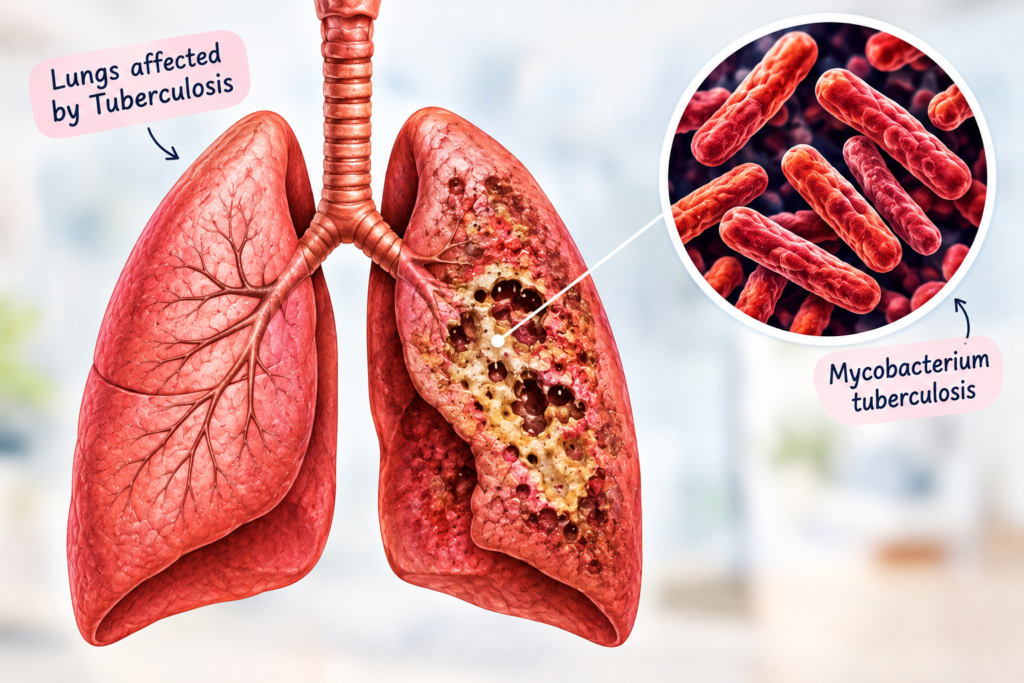
🔬 Types of TB
1. Latent TB Infection (Inactive)
- Bacteria present but not active
- No symptoms, not infectious
- Can progress to active TB later (especially if immunity falls)
2. Active TB Disease
- Bacteria active and multiplying
- Symptoms present and can be infectious (spreads through air)
- Commonly pulmonary
3. Pulmonary vs Extrapulmonary
| Type | Location | Examples |
|---|---|---|
| Pulmonary TB | Lungs | Most common |
| Extrapulmonary TB | Outside lungs | Lymph nodes, pleura, brain (meningitis), kidneys, bones, larynx |
🦠 How TB Spreads (Transmission)
- Spreads through airborne droplets when an infected person coughs, sneezes, or speaks
- Not spread by touching, sharing food, or sexual contact
- Close/prolonged contact in crowded, poorly ventilated places increases spread
🤒 Common Symptoms
Pulmonary TB (Lungs):
- 😮💨 Cough – lasting 3 weeks or longer (key symptom)
- 🩸 Coughing up sputum or blood (hemoptysis)
- 📩 Chest pain
- 😮💨 Shortness of breath
General (Any site):
- 🌡️ Fever (often low-grade, evening rise)
- 💧 Night sweats – soaking sweats at night
- ⚖️ Unexplained weight loss
- 🍽️ Loss of appetite
- 🥱 Fatigue & weakness
Extrapulmonary – depends on the site:
- Brain/meninges → headache, confusion
- Kidney → blood in urine
- Spine/bones → back pain
- Lymph nodes → swollen glands
- Larynx → hoarseness
💡 Memory Trick – “Cough, Fever, Sweat, Weight”
Classic TB symptoms:
- Cough (3+ weeks)
- Fever (evening rise)
- Night Sweats
- Weight loss
“Cough-Fever-Sweat-Weight” = Think TB! 🫁
🔍 Diagnosis & Diagnostic Tests
Accurate diagnosis is the first step in tuberculosis nursing management. The following helps to confirm tb:
- Sputum smear microscopy – AFB (acid-fast bacilli) under microscope
- Culture – the gold standard microbiologic test
- GeneXpert MTB/RIF – rapid molecular test (also detects rifampicin resistance)
- Chest X-ray – lung abnormalities (upper lobe infiltration, cavitation)
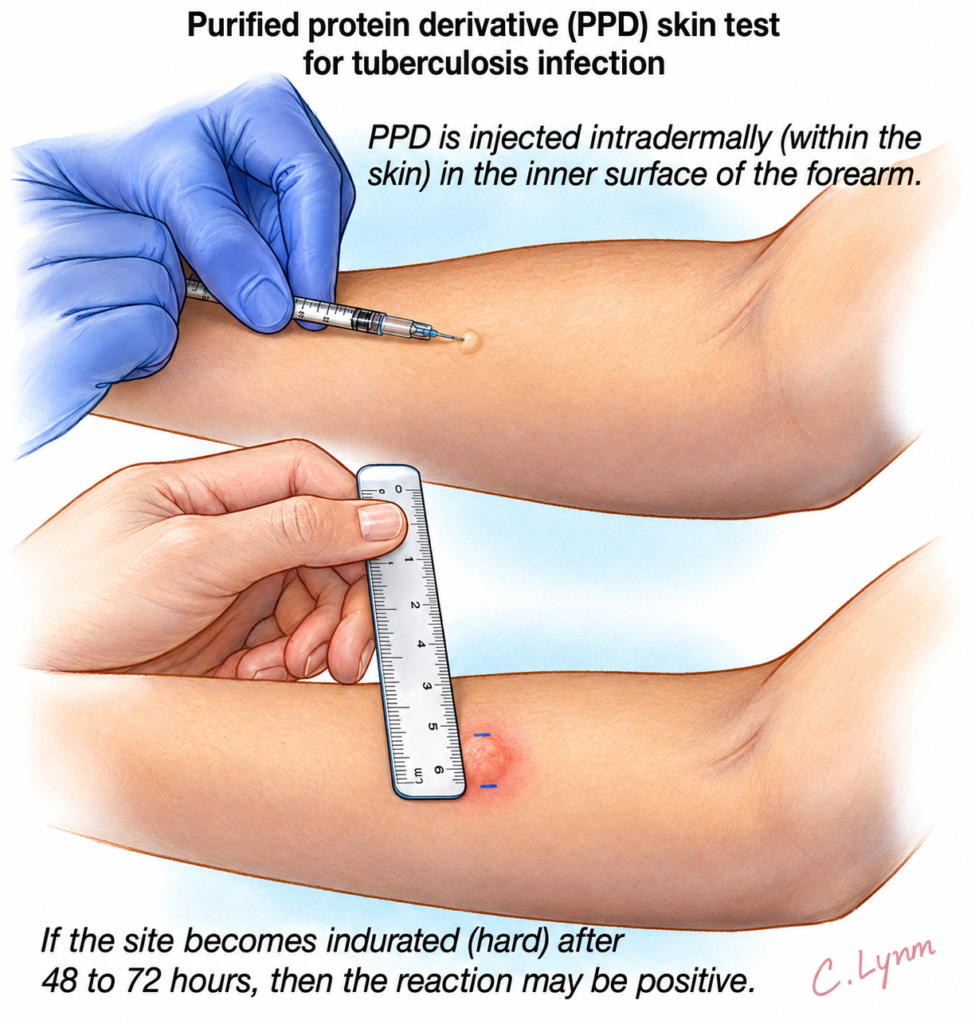
- TB Skin Test (Mantoux/TST) – PPD reaction
- TB Blood Test (IGRA) – blood-based
- CB-NAAT / LF-LAM – for rapid diagnosis & HIV co-infection
Note: Culture is the gold standard, but GeneXpert gives fast results.
💊 Treatment – DOTS (Directly Observed Treatment, Short Course)
Treatment is given under direct observation — a trained person watches the patient swallow every dose. This prevents skipping doses and drug resistance.
DRUG-SENSITIVE TB (NTEP/RNTCP India regimen):
Regimen: 2HRZE / 4HRE
| Phase | Duration | Drugs |
|---|---|---|
| Intensive Phase | 2 months (56 doses) | H Isoniazid, R Rifampicin, Z Pyrazinamide, E Ethambutol |
| Continuation Phase | 4 months (112 doses) | H Isoniazid, R Rifampicin, E Ethambutol |
- Daily dosing, weight-based, with anti-TB drugs (FDC) under observation
Other regimens:
- Latent TB: 3HP, 4R, 3HR (CDC short-course options)
- Drug-resistant TB (MDR-TB): second-line drugs, longer therapy (DOTS-Plus)
⚠️ Never stop anti-TB treatment early — incomplete treatment causes drug resistance (MDR-TB).
💡 What is DOTS? (Important for Exams)
DOTS = Directly Observed Treatment, Short Course — a key TB-control strategy with 5 components:
- Government commitment
- Good-quality diagnosis (sputum microscopy)
- Uninterrupted drug supply
- Directly observed treatment
- Systematic monitoring & accountability
🩺 Role of the Nurse in Tuberculosis Nursing Management
Effective tuberculosis nursing management also involves monitoring drug side effects and ensuring treatment adherence.
- Administer DOTS – watch each dose under observation
- Educate patient – medicines, diet, hygiene, coughing etiquette
- Monitor side effects – watch for drug reactions (e.g., rifampicin → orange urine; isoniazid → neuropathy)
- Infection control – mask, isolation, ventilation, cough etiquette
- Sputum collection – proper technique for smear/culture
- Support & counselling – TB stigma, adherence, HIV co-infection
- Contact tracing – check family members
- Document – treatment card, follow-up smear
- Health talk – community awareness & vaccination (BCG)
🛡️ Infection Control & Prevention
Infection control is a vital part of tuberculosis nursing management . Key measures include:
- ✅ BCG vaccine at birth (protects children)
- ✅ Cover mouth/nose while coughing – use mask/tissue
- ✅ Ventilation – open windows, sunlight
- ✅ Complete full course of treatment
- ✅ Early diagnosis & treatment of active cases
- ✅ Good nutrition & immunity
🧠 Complications (If Untreated)
If tuberculosis nursing management is delayed or incomplete, complications can include:- MDR-TB (multidrug-resistant TB) – drugs don’t work
- TB meningitis – brain infection
- Pleural effusion / empyema
- Hemoptysis – massive coughing of blood
- Respiratory failure
- Spread to other organs (miliary TB)
❓ Frequently Asked Questions (FAQ)
Q1. What is the most common site of TB? The lungs (pulmonary TB) — most cases are pulmonary.
Q2. What is the key symptom of pulmonary TB? A cough lasting 3 weeks or more, along with fever, night sweats, and weight loss.
Q3. How is TB treated in India? With the DOTS strategy under RNTCP/NTEP using the regimen 2HRZE/4HRE (intensive 2 months + continuation 4 months), drugs given under direct observation.
Q4. Is TB contagious? Active pulmonary TB is contagious (spread by droplets). Latent TB is not contagious.
Q5. Why is DOTS important ? It ensures the patient completes the full course of treatment, preventing drug resistance (MDR-TB) and curing TB.
Q6. Why is patient education important in tuberculosis nursing management ? Patient education is a key part of tuberculosis nursing management because it ensures treatment adherence, prevents drug resistance (MDR-TB), and helps break the chain of infection.
🎯 Quick Quiz (Test Yourself)
Q1: Name the bacterium that causes TB. Q2: What is the most common symptom of pulmonary TB? Q3: Expand DOTS. Which regimen treats drug-sensitive TB in India?
💬 Write your answers in the comments below!
📌 Key Takeaways
✅ Tuberculosis nursing management focuses on DOTS supervision, education, and infection control
- ✅ TB = chronic infection by Mycobacterium tuberculosis
- ✅ Most common = pulmonary TB; can be extrapulmonary
- ✅ Classic symptoms = Cough (3+ wks), fever, night sweats, weight loss
- ✅ Diagnosis = sputum smear, culture (gold standard), GeneXpert, CXR, Mantoux
- ✅ Treatment = DOTS regimen 2HRZE/4HRE under direct observation
- ✅ Nurse’s role = DOTS supervision, education, infection control, monitoring
📚 Sources & References
- CDC – Tuberculosis – https://cdc.gov/tb
- World Health Organization (WHO) –https://who.int
- India: National TB Elimination Programme (NTEP) / RNTCP –https://tbcindia.gov.in
- Nurseslabs nursing study guides
📌 Related Posts
Related posts other than Tuberculosis nursing management:
